
ERG, Explained
Why is structural testing alone not sufficient for retinal disease management?
Two patients can look nearly identical on an OCT, but they may progress very differently. Why? Structural imaging only shows the anatomy of the retinal tissue and is subjective to several factors, including patient compliance. Retinal dysfunction can also precede structural damage.1 That’s why functional assessments, such as electroretinography (ERG), are an important component of the ophthalmic diagnostic suite—to help providers identify disease and categorize their high-risk patients before complications develop.2
¿Qué es la electrorretinografía (ERG)?
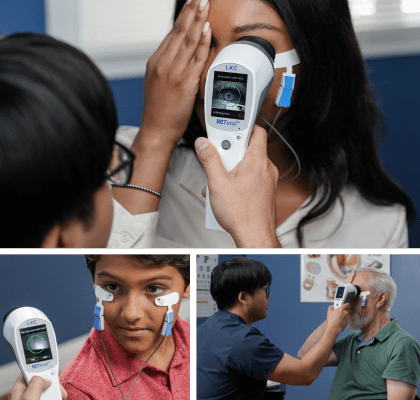
You may have heard of an ECG (electrocardiogram), which is a test that measures the electrical activity of the heart. An ERG, or electroretinogram, works similarly for the retina.
How does an ERG test work?
During an electroretinogram (ERG test), patients’ eyes are stimulated with light. When this stimulus hits the back of the eye, the resulting electrical activity is measured by skin or corneal electrodes. The way the retina responds can provide vital, objective information about a patient’s retinal function and health.
Are there different types of ERG tests?
There are 3 main types of ERG tests, each with different applications and benefits. Retinal function testing with these various types of ERG gives clinicians, researchers, and veterinary ophthalmologists a way to reliably monitor retinal changes or disease progression over time.

What is full-field ERG (ffERG)?
Full-field ERG uses a summed electrical response from a range of different cells and regions in the retina, revealing the full picture of a patient’s retinal health. The portable, handheld RETeval device is capable of performing this type of ERG test.

What is pattern ERG (PERG)?
During a pattern ERG test, an alternating checkerboard pattern is used as the stimulus to read electrical responses from the ganglion cells that compose the inner retina. This type of ERG is most commonly used to test for disorders affecting the ganglion cells and some neurodegenerative disorders.

What is multifocal ERG (mfERG)?
A multifocal (mfERG) test is performed with a similar protocol to a PERG, but the light stimulus displays as an array of hexagons that flicker from black to white in a pseudo-random sequence. mfERG is best used to measure central retinal dysfunction.
¿Qué es un electrorretinograma?
The electroretinogram (ERG) is an examination that evaluates the function of the eye’s retinal cells. Patients’ eyes are stimulated with light and the resulting electrical activity from their retinal cells is measured by skin or corneal electrodes. Dependent on the type, intensity and colour of the light stimulus information on different areas and types of cells can be obtained.
Detectar estrés funcional
Anticipar daño estructural.
¿En qué se diferencia la electrorretinografía de una imagen estructural?
La electrorretinografía evalúa objetivamente las anomalías de la retina, mientras que las imágenes estructurales muestran la anatomía del tejido de la retina. Si bien tanto las evaluaciones funcionales como las estructurales tienen sus beneficios, los cambios funcionales generalmente aparecen mucho antes que los cambios estructurales. Detectar rápidamente las anomalías de la retina es fundamental para minimizar el daño y maximizar la retención de la visión, por lo que las evaluaciones funcionales como la ERG son herramientas importantes en el conjunto de diagnósticos oftalmológicos.
ERG portátil como herramienta de diagnóstico práctica y eficaz
Recent studies comparing ERG to structural imaging techniques show that ERG is an effective diagnostic tool. In studies comparing ERG and structural imaging’s abilities to evaluate sight-threatening diabetic retinopathy, the handheld and portable RETeval device’s ERG results outperformed the traditionally-used imaging technique in predicting which patients would later need medical intervention.[13],[14] En una evaluación de la capacidad de RETeval’s ability to evaluate diabetic retinopathy, the advantages of RETeval incluyeron la detección temprana de la disfunción retiniana, menores costos de inversión y menos conocimientos de lectura requeridos que la técnica de diagnóstico por imágenes utilizada tradicionalmente.[15] En una evaluación de la capacidad de RETeval’s ability to evaluate central retinal vein occlusion found that RETeval son menos invasivos, más fáciles de realizar y brindan predicciones más confiables que la técnica de imágenes que se usa tradicionalmente.[16]
Ventajas de las pruebas ERG
La facilidad y sensibilidad de los ERG realizados con el RETeval portátil es muy preferible a las técnicas de imagen en determinadas situaciones. Los pacientes que tienen opacidades mediáticas, mala cooperación o pupilas pequeñas pueden ser evaluados mejor para detectar anomalías en la retina con el RETeval[14].
Pruebas ERG no invasivas
En un estudio independiente en el que se compararon los ERG de RETeval con las fotografías digitales convencionales de la retina, los pacientes eligieron el RETeval como el método preferido sobre la fotografía.[14] ] Si bien muchos niños necesitan ser sedados para someterse a una ERG convencional, los niños de tan solo seis meses de edad han podido mantener la calma durante las ERG realizadas con RETeval.[18] La naturaleza no invasiva del ERG y la facilidad del RETeval portátil y no midriático hacen que el dispositivo ERG sea una valiosa herramienta de detección para muchas patologías oftálmicas.
RETeval, pruebas ERG simplificadas
Aplicaciones de la electrorretinografía
La electrorretinografía presenta una amplia variedad de aplicaciones en humanos y animales, tanto para uso clínico como de investigación. Nuestra tecnología ofrece soluciones de ERG fiables, reproducibles y efectivas en todas estas categorías.


More about the RETeval ERG/VEP device
Popular Topics: Make a Difference in Diabetic Retinopathy Care | Glaucoma Evaluation with RETeval PhNR Test | RETeval Device Reference Data | RETeval in Optometry
Case Studies: When Standard Tests Aren’t Enough: Using ERG to Support Diagnosis in Case with High Myopia | DR Score Helps Overcome Blind Faith in Popular Weight Loss Drug |A Family Affair: ERG-Guided Care for a Married Couple | DR Score Prompts Critical Referral | A Tale of Two Patients: How ERG Uncovered Hidden Differences |ERG Supports Treatment Decision in Diabetic Retinopathy | ERG Demonstrates Stable Function Despite Severe Structural Damage | ERG Supports Treatment Decision in Diabetic Retinopathy | Photopic Negative Response as a Reliable Method for Glaucoma Follow-up in Children | A Tale of Two Patients | Vision Complaints Reflected on ERG | Predictive Value of Combining Diagnostic Technologies| ERG Provides Clarity When Fields and OCT Are Inconclusive| ERG Raises Red Flag, Changing Management Trajectory | ERG Provides Confidence to Monitor or Treat | ERG to Determine Ischemic Status | ERG to Replace FA for CRVO Treatment Decision | Using ERG to Monitor Glaucoma | Routine ERG Use Supports Complex Patient Management | ERG Alters Follow-up Schedule and Education for Patient with Diabetes | Using ERG for Management of Birdshot Chorioretinopathy | Using ERG to Monitor Glaucoma | Comprehensive Pediatric Assessment Using ERG in Challenging Cases | ERG Above and Beyond Retinal Imaging | ERG’s Role in Diabetic Retinopathy Progression Monitoring | Evaluación de riesgos basada en ERG en CRVO | ERG Supports Diagnostic Accuracy in a Pediatric Patient
Ebooks: How Modern ERG Became Essential for Diabetic Management | Core Cases from the Clinical Compendium | Modern Fundamentals of Diabetic Retinopathy Management in Optometry | Elevating Patient Care with ERG
Articles: Electroretinography Added to AAO’s Diabetic Retinopathy Preferred Practice Pattern Guidelines | ¿Es cómodo el dispositivo RETeval para los pacientes? |The Use of RETeval ERG/VEP en oftalmología pediátrica | How RETeval ERG Has Enhanced My Practice | The Use of RETeval ERG/VEP in Pediatric Ophthalmology | The Ultimate Guide to Diabetic Retinopathy in Primary Eyecare | What Type of Functional Testing Do You Prefer for Patients with Diabetes? | Major Milestone: RETeval Referenced in over 200 Publications | Collaboration to Elevate the Standard of Care for DR | Is ERG Needed if You Have Access to a Good Structural Imaging Device? | UN ENFOQUE SENCILLO PARA EL MANEJO Y APOYO DE LOS PACIENTES CON DIABETES | Simplify Grading and Risk Assessment in Diabetic Retinopathy | Simplify Daily Decision-Making with Modern ERG | Objective Functional Testing Needs in Diabetes and Glaucoma | Why Modern ERG is Re-Defining Diabetes Management | Diabetic Retinopathy Management Protocols for Optometry
Videos: RETeval: Helping You Assess Progression Risk | RETeval: Eliminating Confusion in Clinic | RETeval: More Information, Better Decisions | RETeval: Eliminating Confusion in Clinic | RETeval: Function to Rely On | RETeval Handheld ERG: Features & Benefits | RETeval: Enhancing Collaborative Care | Handheld ERG for Primary Eyecare | Advice for Optometric Colleagues about Handheld ERG | Making a Difference in Diabetic Retinopathy Care | Changing the Way We Think About Electrodiagnostics | ERG Testing Made Simple | VEP Testing Made Simple | ERG Waveform | Introduction to Visual Electrophysiology | A Superior DR Progression Risk Assessment with the RETeval manual y portátil, | Improve Glaucoma Management with the RETeval Handheld ERG Device | Reshaping the Retinal Diagnostic Landscape | New Solutions for Infants with ROP | Using the RETeval in Myopia Research
Webinars: ABCs of ERG | ERG in the Exam Lane | Ready for RETeval | ERG in Action | Blueprint for Functional Assessments | Predicting Vision Loss in a Busy Retina Practice | Objective, Functional Testing for Glaucoma? | Best Management Practices for Diabetic Retinopathy | How the RETeval Device Became a Daily Instrument in my Diagnostic Toolkit
¡Hablemos!
Solicite una demostración o más información sobre nuestros dispositivos.