LKC Technologies
English
English Español Português 日本
  • Products
    • For Humans
      • RETeval
      • UTAS mf/PERG
      • Sensor Strips
    • For Animals
      • RETevet
      • Request Demo
      • Order Supplies
  • Applications
    • Visual Electrophysiology
      • Electroretinography (ERG)
      • Visual Evoked Potential (VEP)
    • Clinical Conditions
      • Diabetic Retinopathy
      • Glaucoma
      • Retinal Ischemic Diseases
      • Inherited Retinal Disorders
      • Miscellaneous
    • Animal Applications
  • Resources
    • Case Studies
    • eBooks & Reports
    • Webinars
    • Articles
    • Research
    • Podcasts
    • Blog
    • Videos
    • Software
  • About LKC
    • Vision & Mission
    • Team
    • Clinical Advisors
    • Testimonials
    • History
  • Contact
  • Academy
  • Buy Sensor Strips
  • Schedule a Demo

Enhance the glaucoma picture Measure ganglion cell function

PhNR testing with the RETeval® is a vital tool for managing patients with glaucoma and other optic nerve diseases with objective assessments of ganglion health.

Book a demo

Why conduct an ERG test for glaucoma?

Early diagnosis is essential to preserve vision loss from further degeneration of ganglion cells.

However, glaucoma is often challenging to diagnose and manage. Testing such as perimetry and OCT imaging are standard of care, but are all too often hampered by media opacities (imaging for cup-to-disc-ratio), unspecific testing methods (IOP), or subjective and bothersome to complete (visual field test).

learn more about RETeval
Did you know?
0 %

of true glaucoma patients remain undiagnosed[41].

0 %

of glaucoma patients are over-treated[41].

What is a PhNR Test?

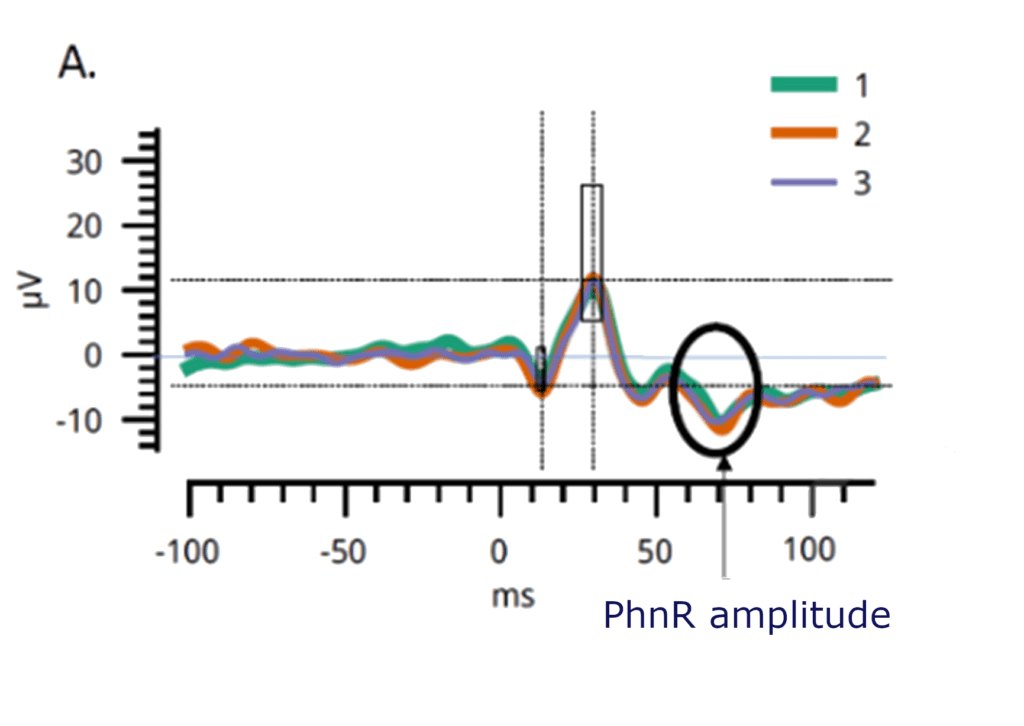
PhNR stands for Photopic Negative Response and is an electroretinographic test for analyzing how the ganglion cells function.

During the Photopic Negative Response test with full-field flash ERG, the retina is illuminated with a red flash on a blue background under light-adapted conditions. This last negative peak is derived from the ganglion cells and their axons and is generally used to evaluate subjects for Glaucoma.

The PhNR response from ERG is described by a time (implicit time) and amplitude. For glaucoma diagnosis and management, several parameters are given as the disease itself is complex [37].

How does the RETeval make PhNR testing easier?

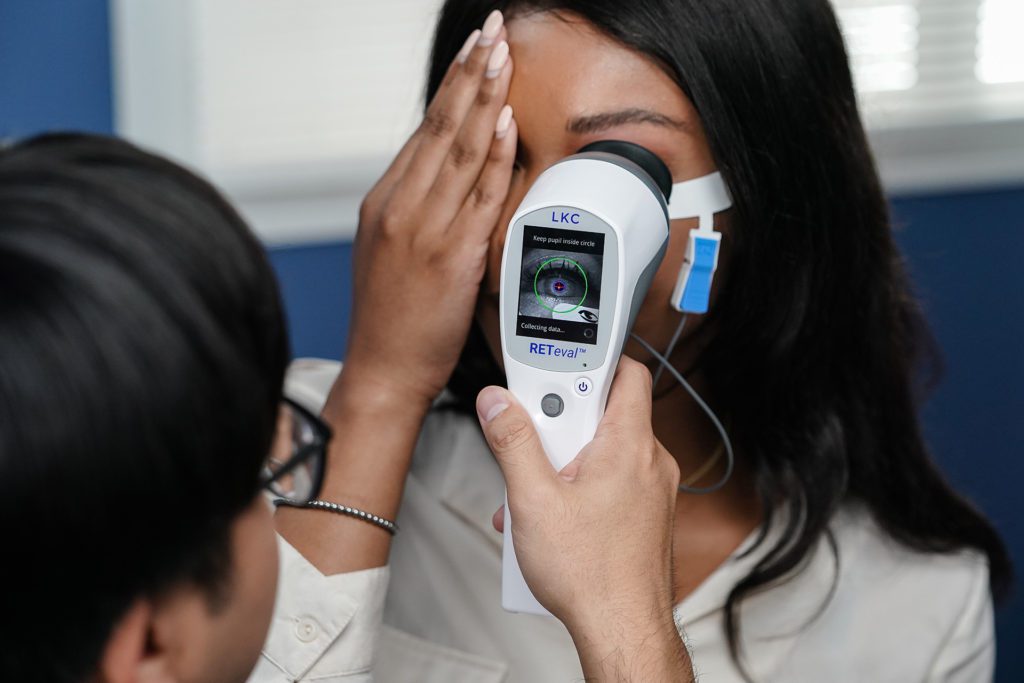
The RETeval PhNR test objectively measures ganglion cells function by evaluating the electrical activity of the cells to a light stimulus. Knowing how the ganglion cells are functioning may assists in detecting and monitoring glaucomatous changes in patients.

The test provides high objectivity and repeatability, is independent from media opacities and is suitable also for patients with reduced motor and cognitive skills [31][32][34].

Dilation not required

Real time pupillography continuously adjusts for pupil size and can be used for patients in any stage of dilation

No corneal contact

Our patented, non-invasive Sensor Strip skin electrodes mean that no corneal electrodes are required.

Simple to use & to interpret

The handheld RETeval device is light, portable, and easy to use. Technicians can be trained in minutes.

Detect Optic Nerve Dysfunction

The RETeval Device is expected to detect changes with a high degree of accuracy

Kita et al. have compared seven parameters of the RETeval PhNR test for their ability to differentiate between early or moderate glaucoma from a healthy control group. In this study, high accuracy of the PhNR test was found [38].

accuracy
0 %

(Early glaucoma)

Analyze the PhNR Amplitude at minimum

accuracy
0 %

(Moderate glaucoma)

Analyze the PhNR W-ratio

Monitor Disease Changes

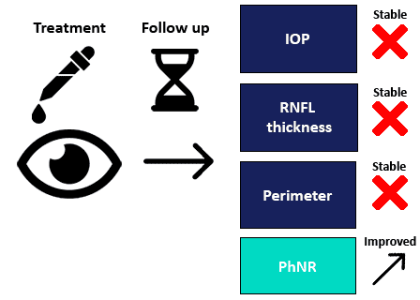
PhNR testing with the RETeval Device provides sensitive, objective monitoring of retinal changes for more informed follow-up, even where no changes in visual field or RNFL could be detected

Hui et al. detected improvements in the inner retinal function after treatment with nicotinamide, where no improvements in visual field or RNFL had been seen [39].

Glaukoma-treatment-graph2

Unleash the Power of ERG Glaucoma Testing with the RETeval

optimal test-retest capabilities

Our new algorithm provides a significant improvement in test/retest variability, leading to improved ability to track patient progress longitudinally. Additionally, the reference range is narrower, leading to an enhanced ability to aid in the detection of abnormal ganglion cell function.

Versatile, yet standardized

The protocol is ISCEV* compliant, uses the most effective stimuli settings, and is available in different configurations that allow physicians to adjust according to patient conditions (short and long test options, mydriatic and non-mydriatic).

*International Society for Clinical electrophysiology of Vision

Learn more about Reteval
Sample Reports

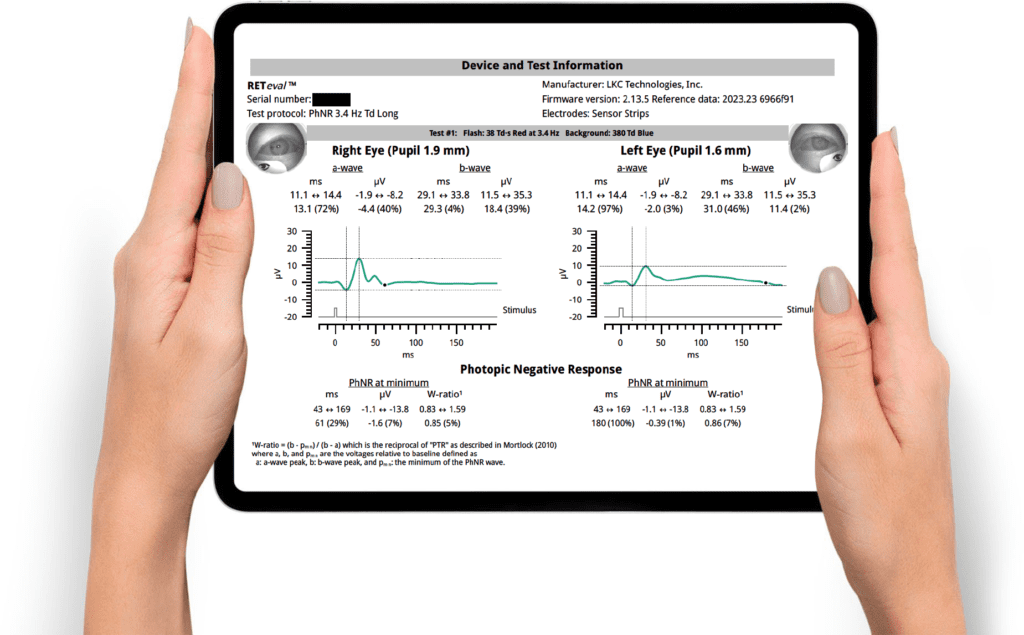
The PhNR test report gives the amplitude and implicit time of the two first waves.

The typical PhNR values such as amplitude and implicit time at the minimum are shown below the curves. For the support of a differential glaucoma diagnosis and management, other parameters have been analyzed by researchers, such as the W-ratio, which is calculated from the PhNR, a-, and b-wave amplitudes.

Our updated PhNR reports put all the criteria you need to consider dysfunction front and center, allowing you to make better clinical calls for your patients while saving valuable time.

Sample Report

452DB777-D65E-4152-A88D-4833492FFE5B@2x PhNR – Glaucoma

Other clinical applications

Objective testing of ganglion cell function with the PhNR can be used to assess a range of optic nerve neuropathies [40]. This includes:
  • Ocular Hypertension
  • Leber Hereditary Optic Neuropathy
  • Optic Nerve Atrophy
  • Idiopathic Endocranial Hypertension
clinical applications
ERG test with the RETeval handheld device

Let’s Talk!

Request a demo or a quote for the RETeval

  • Products
    • RETeval
    • UTAS mf/PERG
    • Sensor Strips
    • RETevet
  • Electrophysiology Tests
    • Electroretinography (ERG)
    • Full-Field ERG (ffERG)
    • Pattern ERG (PERG)
    • Multifocal ERG (mfERG)
    • Visual Evoked Potential (VEP)
    • Address20501 Seneca Meadows Parkway, Suite 305
      Germantown, MD 20876 USA
    • Phone+1 301 840 1992 (US & Canada)
      +358 40 8486625 (International)
    • International Distributors
      • Medical Device Distributors
      • Veterinary Device Distributors
  • Follow LKC Technologies on LinkedIn
  • Follow LKC Technologies on Facebook
  • Subscribe to LKC Technologies on YouTube
  • Follow LKC Technologies on Instagram
LKC_AMETEK_website_logo_RGB_color
© 2026 LKC Technologies, Inc.
  • Accessibility Statement
  • Terms & Conditions
  • Certifications
  • Privacy Policy
  • Do Not Sell or Share My Personal Information
  • Cookie Policy
  • Careers

California Proposition 65 information

Prop-65Warning: This product can expose you to chemicals including lead, which is known to the State of California to cause cancer and birth defects or other reproductive harm. For more information go to www.P65Warnings.ca.gov.

Substance Tables:

The table below lists substances which may be contained within LKC’s RETeval and RETevet products. Substances listed as Type 1 are within permissible levels in one or more of LKC’s products. Substances listed as Type 2 are used in the production of some components used in LKC products and may be present at trace levels, but are typically destroyed during processing. 

RETeval and RETevet Devices

Substance CAS # Type Listed as causing:
Nickel 7440-02-0 1 Cancer
Acrylonitrile 107-13-1 2
Ethylbenzine 100-41-4 2
Crystaline Silica 14808-60-7 1
Lead 7439-92-1 1 Cancer Developmental Toxicity Male Reproductive Toxicity Female Reproductive Toxicity
Methylene Chloride 75-09-2 2 Cancer Female Reproductive Toxicity
Bisphenol A 80-05-7 2
N-Hexane  110-54-3 2 Male Reproductive Toxicity